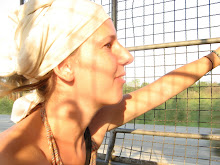
Armed gangs of youngsters drive through the streets in their pick ups. You can’t pass any of the many new checkpoints along the roads without being stopped and facing their one policy for all in the name of ‘protection against the enemy’. People are powerless and prepare themselves by putting their belongings in plastic bags. The enemy attacks have reached new heights so the rebel’s interference, even when mobilizing many children, is justified and accepted by the people. Umbrellas no longer protect us from the heat so the water attacks launched from guns and buckets are ‘refreshingly’ welcome. The Water Festival has started!
This morning after waking up very early for the fourth day in a row with the sound of Thai music and speeches I discovered the ‘sound device’ attached to an electricity pole eight meters away from my window. I hope it is related to the festival which will end on Wednesday!
Later today six new people arrived to our house and bring the news that one of my friends from inside will marry soon, likely this means partly giving up her freedom. I still hope one day she can become a minister. But Burma will have to change a lot and very fast for this to be socially and politically possible.
Saturday, April 12, 2008

Wednesday, April 9, 2008
morning thoughts
I woke up with the sound of what seemed an endless and boring Thai speech coming through a bad quality speaker, I guess attached on a pick-up. You see them regularly in
At the same time one of my ‘brothers’ continues his work on a campaign project to convince his people in the mountains of Burma to go and vote against a constitution that keeps the military regime in place. It will be a dangerous project. If one of them gets caught with the pamphlets and T-shirts or with the cameras that will be used to report about their observation of the referendum, …. I don’t want to think about it. Fear does not change anything.
Yesterday I was one of the many guests at the house of one of the parliamentarians elected in 1990. The neighbouring house was a newly build place hosting four young woman who set up a Kayan Women Organisation. Several English diplomas of successful participation in training courses decorate the wall. The girl who received them hardly speaks English but proudly shows me pictures of her meeting with Pinheiro, the special rapporteur to the UN Human Rights Council, in 2005. The next house is the house of Padoh Mahn Sha, the man who was murdered there on the 14th of February. It was the house where my Estonian friends and I were warmly welcomed on the 14th of January. I feel an indescribable discomfort.
Among the many people were mothers and sons who had not met for eight years or people who had made it to the promised land to become so involved in their work as computer programmers or cashiers in the supermarket lacking time to follow what happens in their homeland. There were fathers who had not attended the wedding of their sons or who had not seen their daughters for three years or more. The group of ten guests arrived on Monday with a one day visa. “Yes, the fine (bribe) for overstaying your visa is pretty expensive but we traveled three days from Phekhon to Mae Sot, to see our family and friends!” A 21-year old boy is excited and tells me about his plan to stay, find a job, study and go to
I think about the road I walked since nine months and where I am headed. I don’t know. Yesterday I felt a bit lost, disappointed and desperate. I hope today brings me hope. Hope for my friends.
Saturday, April 5, 2008
On the Reality and the Future of Burma
On the first day I arrived in
The people in
Nothing is what it seems and so many books and researches reveal this. Many actors keep up a ‘fake reality’. An opposition group for example sends their request for amendments of the proposed constitution to the ‘officials’ but admit that it is just to ‘show’ the people (in this case their own ethnic group) that they think about them, or using a frequently heard saying: “that they are doing for the people”. Even without receiving an answer they know their requests will be ‘not accepted’.
Researching about future political parties and the activities of another strange group called the Union Solidarity and Development Association (USDA), stated to be a government –operated NGO, I ask if somebody can confirm my feeling that they might become a political party. Some said vaguely to know something about this being announced. This morning I find a study from 2006 titled: The white shirts. How the USDA will become the new face of
The second book I find is Secret Histories. Finding George Orwell in a Burmese Teashop. Orwell is sometimes said to be the prophet of
In a country full of fortune tellers, prophecy newspapers and where ‘official’ decisions are often based on horoscopes, the future ‘seems’ more uncertain than almost anywhere else. Nobody knows what will really happen tomorrow. Some however did make some plans!
Will the ‘secret’ plan of the military top continue to be implemented at all costs? It reminds me of the Project for a New American Century (PNAC), a think thank that contributed to the strategic planning of the
The future of
Thursday, April 3, 2008
We can support the people in Burma with money but we can also do a lot with priceless willpower!
I can no longer believe in big international institutions who fail to do what they preach. So many international agreements and obligations exist and institutions claim to work, with tax-payers money, for the good cause. Burma is obliged to protect and promote human rights by so many international conventions but is not adequately punished by any of those who proudly state to be a signatory of those international instruments.
An expulsion of Burma from those conventions and international organisations would be a strong, clear and just message of support for the people in Burma. If being a member of those organisations makes real positive differences a democratic Burmese government should be able to regain membership!
At national level it is all about diplomatic relations and much more about trade relations. A country like Estonia for example, that has neither of them, is in theory free to speak up. But likely it has to admit to be afraid of countries like Germany and the UK. Both are among the biggest foreign investors in Burma and simultaneously speaking loudly in the European Parliament about economic sanctions that don't hurt them too much (UK) or acting bravely and refraining from publicly signing profitable energy deals (Germany). So did Estonia, being part of the EU, de facto gave up its right to take a stand in international relations?
The EU, in my eyes, voluntarily paralyses itself in its bureaucracy but still proclaims to use all its energy and effort to support the people of Burma. When will the EU look for new tools to deal with dictatorships? The sanctions work maybe partly but the negative consequences being for example China jumping into investment vacuums likely surpass the positive effects. And by know the EU should know that the generals don't listen to friendly demands. EU officials are also educated enough to read the extensive documentation on the situation in the country, from opposition, government and international sources, to identify incoherences and valid evidence and to make conclusions.
The people of Burma have the willpower to develop their own country. They don't ask for money but they ask for the truth to be known. The main (only) obstacle for development is its military regime, to overcome this obstacle they need protection! Are their any institutions providing People-protectors? Could 100.000 foreigners act as a human shield from the guns of the Burmese army? Can we send 55 million bulletproof vests? Can we do something?
But of course who will be WE?
Internal struggles
Regardless of the slogans used by all sides (government, political opposition groups or even the Mae Tao clinic in Mae Sot) stating to be United in Diversity, I noticed a strong emphasis on differences in ethnic background and religion coinciding unfortunately with a lot of strong statements and judgements.
Discrimination seems to run through all levels of the society. Karen government teachers gave up their jobs facing unfair lack of any chance to be promoted compared to their colleagues. A Muslim man with his five year old son tells me he is a retired government official. I later read that the members of the Muslim minority are excluded from living and working in the new capital Naypyidaw, literally meaning royal bellies. Also in Yangon the few Muslim schools can only be found at the outskirts. My trishaw driver in Mandalay described a job interview as starting (and ending) with the question about the profession of his father. And the bilingual (Burmese/Chinese) schools in Myanmar only allow Chinese descendants. Of course the biggest difference remains between those who have money and those who don't, between those who wear the uniform and those who don't.
Many people in Myanmar feel very inferior but similarly always seem to find another group to pity and speak bad about. Being shy is considered (teached) to be polite and asking questions is discouraged. In an environment where one is socially and brutally oppressed from expressing ones opinion and feelings or where being different and breaking social codes, traditions or norms is not accepted, the toughest struggle is not the one for food but the internal one. Dreams, hopes and traumas are kept in mind and hearts.
Other struggles take place within an among the many opposition groups. Some are without doubt aroused by the SPDC in the framework of its divide and rule policy inherited from the British. These struggles however are far less secret than the internal distrust existing within the SPDC. The biggest and by some also expressed as the only hope for the people is exactly a fatal or self-destroying split in the army. The dictator himself Than Shwe is over seventy and very ill. Other top leaders are already fighting among each who will take over. Signs of fear and disagreement were also visible when three years ago they put the former prime minister who was a bit too progressive under house arrest. While the top of the military is losing its unity due to greed and mismanagement, simple soldiers go through hardships that might soon be too much for them. Most of them did not become a soldier out of free will. My trishaw-driver in Mandalay told me how the soldiers approach young village boys upon arrival to the city , mostly in search of work, with two choices: the army or prison. Family would find out maybe three years later what happened to their son. Once in the army one cant leave legally without passing through prison for at least three years. Soldiers farm, sleep in houses sometimes worse then those in the refugee camps and don't have great food or equipment. But they do have guns and are still better off than many of their fellow countrymen. The recent atrocities against the monks were also intolerable for many Buddhist soldiers and increased oppressed anger. Some escape while for example five soldiers recently choose the camp of an armed opposition group, the KNU (Karen National Union), due to injustice among the soldiers.
Wednesday, April 2, 2008
'Going inside'
The first time since I left
One of the hardest things for me about Myanmar is to measure the hope and assess the fear and danger among the people living under a cruel dictatorship.
Secondly I still do not know how to call this land. I asked many but most people inside seem to use Myanmar instead of Burma used by outside support groups. Burma is the name given by the British and strongly related to the name of majority of ethnic Burmans, and their language Burmese. Myanmar, literally meaning ‘quick strong’, is the name chosen by an illegal brutal military government disliked by most of the citizens, however more inclusive according to some members of the minorities. Equally confusing is that people define themselves as being ‘Myanmar’ but easily use words like Burmese food or Burmese army. Forgive me to use both.
Gambari and Sue visit Yangon
Before I wonder why the people did not move and why the police gathered near Sule Pagoda in the centre of Yangon (former Rangoon) I hear the name Gambari, the United Nations envoy for Myanmar. Soon some pick-ups with armed soldiers and a black car pass by after which the passers-by resumed their doings without showing any feelings.
“He comes and goes without bringing hope for the people” said the two priests I spoke on 5th of March. Next evening sister Cecilia, showing me the newspaper The New Light of Myanmar, says: “Gambari is here but no news about the content of the discussions, just a picture and the shedule of his meetings”. Some others tell me there is a rumour or a joke that he received some rubies.
In my hotel there is again no Internet connection. “Because of Gambari” the staff and clients whisper. The country’s two Internet servers are controlled by the military government. Access to the world wide web is scarce, especially outside the big cities, the connection sometimes (often) does not work or is extremely slow and if you manage to open your mailbox you are warned about ‘spies’ watching what you read and what you send through the servers. I do have access to the BBC TV-news reporting that Gambari is accused of being biased and of conspiring with Aung San Suu Kyi. The Generals also informed Gambari that no changes would be made to the proposed (unpublished) constitution.
The majority of the population in Myanmar struggles daily to survive and does not question politics to openly, exactly what the military regime wants. But those who had, often abroad, access to ‘higher’ and ‘more free’ education are very concerned about the plight of the people. “We try to inform the people about issues like AIDS, human trafficking but also about the dangers of the proposed constitution. But it is difficult, the people don’t understand” said the Sister. The Priests and Sisters emphasised their (obligatory) non-political role but they do share the wish for change.
The proposed constitution equals the prolongation of the military dominance for example by reserving 25% of parliamentary seats for the army. Opposition- and minority groups have little hope to get representatives elected due to regulations for establishing political parties and also Aung San Suu Kyi is excluded because of her marriage with a foreigner. The military government, The State Peace and Development Council (SPDC), warned the people in The New Light of Myanmar of March 5th that a 100% democracy is not possible and refers to the
The people mostly speculate about the way the referendum will be organized and some mention forced mass demonstrations. The Referendum Law for the Approval of the Draft Constitution (3,5 pages) was however published in the newspaper of February 27th in Burmese and February 28th in English. Repeatedly people told me newspapers are no longer read because “too many lies”. Unfortunately some activists miss out on some useful information this way. It is for example also possible to purchase a preliminary version of the constitution published in September
There is a lack of public debate and citizens can only discuss secretly the content of the constitution. Criticism can be punished with imprisonment up to three years. The owner of an Internet cafe was forced to close his business because he allowed clients to print a ‘political’ document. The government anyway causes enormous disruptions for people to communicate by controlling and shutting down the Internet and access to electricity. During and after the September protests also mobile phone connections were cut off.
The demonstrations in August and September and the short international media attention gave hope but simultaneously increased both anger and fear. The ‘silent’ activists remain realistic: “We know no country will interfere without served self-interest and we know we still have a long way ahead”. The people have no way how to protect themselves from the guns of the army but they crave for change. Opposition- and student leaders are almost all arrested or killed and everything is dangerous not only for the people directly involved but for family and neighbours as well. People told me about the shared desire expressed by the applause given in theatres and the mumbling in the tea shops. The latter I would witness many times across
Non-violence remains the wish of the people but the military government has repeatedly made clear not to be willing to hand over the power. “They are soldiers, they fight till they die”, my friend said followed by a painful silence filled with despair.
Old news from border town Mae Sot, a prologue to my Birma trip!
The new Rambo movie, in the cinema’s across Europe since January but not in
The world attention, if going to
When a regime guilty of genocide and oppression of opposition groups and citizens is regains credibility among the international community due to this announcement, I believe it only shows how irresponsible the creditor is. Only somebody who consciously chooses to believe words instead of looking at the deeds and extensive proof can be so foolish to believe a liar.
As for the word-game the military junta became a winner. With the
In reality the proposed constitution ensures the continuation of military rule with 25% of the parliamentary seats reserved for appointed officers and veto powers for decisions of the parliament. The proposal is not meant to be discussed and criticism may lead to imprisonment. Arrests of activists have not stopped and ethnic cleansing increases in
Here in Mae Sot the border was closed for illegal crossings on Wednesday 20th after an explosion at a waste dump. Later on order in town was maintained by a ban on drinking and buying alcohol in the light of local elections from February 23rd to 25th. The ban existed only on paper. The daily random arrests of Burmese people continued. The Thai police would keep them in a big cage, receive money from
At the end of the month my friend asked me to visit his country, I would meet his friends soon and the journey would be meaningful.
Subscribe to:
Posts (Atom)